
How to Search Civil Dockets
Open with Search ARCourts. You can look up a person or organization by name, or search by case description. Advanced filters narrow the results. Filter by Sevier County, court location, case type, filing date, and docket code. Already have a case number? Switch to the Cases context and enter it directly. Here is what a real Sevier Circuit civil number looks like: 67CV-24-124. That string folds in several parts. It carries the county prefix, the civil code, the filing year, and the sequence.
Before you open a result, confirm it matches the right court and the right parties. Similar names produce false matches all the time. Then work through the case summary, the participants and their roles, Case Events, Docket Entries, judgment information, and any document links you are eligible to view. Basic public use of Search ARCourts costs nothing. It is not legal notice, though, and it cannot produce a certified record.
- Choose participant search for a person or organization, or case search when the number is known.
- Apply Sevier County, court-location, civil case-type, docket-code, or sensible date filters.
- Match the court, case number, caption, filing date, and status.
- Trace the complaint, service, answer, motions, notices, orders, judgment, and later entries.
- Ask the correct clerk for an unlinked filing or certified copy.
Sevier Civil Court Choices
Civil cases in Sevier County do not all land in one place. The Circuit Court takes the bigger share. It holds general civil and domestic-relations jurisdiction. The Sevier County Circuit Clerk keeps the civil docket and the domestic docket separate for each of the two Ninth West judicial divisions. District Court works on a smaller scale. It hears contract claims, personal-property damage or recovery cases, and small claims within its statutory authority. The statewide judiciary description currently states limits of $25,000 for District civil matters. Small claims run to $5,000. So the size and type of a dispute decide which court docket it lands in.
| Route | Typical matter | Custodian |
|---|---|---|
| Sevier Circuit Court | General civil and domestic-relations proceedings | Sevier County Circuit Clerk |
| 36th District Court | Lower-value civil and small-claims cases | De Queen Department clerk |
| Probate Court function | Estates, guardianships, and adoptions | Sevier County Clerk |
That split shapes any Sevier County docket search. A missing Circuit result does not mean the case never existed. The file may sit in District Court or at the County Clerk's probate counter instead.
What a Civil Docket Shows
A Sevier County civil docket is a running log of process. It is not merely a final judgment. In the participant area you will find plaintiffs, defendants, petitioners, respondents, organizations, and attorneys where public. The event list covers hearings that are scheduled or already held. Each Docket Entry marks when a complaint, answer, motion, notice, order, or judgment hit the file. An entry may link an eligible public document.
| Case Summary | Case number, filing date, court, case type, status, and assigned judge. |
|---|---|
| Participants | Public names, roles, and aliases tied to the civil case. |
| Case Events | Date, time, event, room, location, and judge for settings. |
| Docket Entries | Filing date, description, details, filer or role, and eligible document links. |
| Disposition | Judgment, dismissal, nonsuit, agreed order, or other exact outcome label. |
| Later Activity | Writs, garnishments, appeals, satisfactions, and other post-judgment filings. |
A status line on a civil docket can be vague. Pull the actual judgment or dismissal entry to see how the case truly ended.
Sevier Civil Filing Sequence
Most Sevier County civil dockets open the same way. A complaint or petition gets things started. Next comes a summons and service entry, showing that process went out or was completed. From there, the other side may answer. Motions ask the judge to act; orders record what the judge directed or ruled. Hearing dates surface through notices and Case Events. A judgment or dismissal may settle the main dispute, though enforcement and appeal entries can still follow it.
Civil docket flow: Petition or Complaint › Service › Answer › Motion › Hearing › Order › Judgment
Read the whole sequence, not one keyword. A motion for judgment remains a request. An order must grant or deny it before it becomes anything more. A notice of hearing only announces a setting; it does not prove the hearing happened. Dates, descriptions, and linked filings tell the real story together.
Sevier Civil Motions and Orders
A motion is a request, nothing more. Seeing one filed in a Sevier County civil docket does not mean the judge granted it. Track the entries that follow: the response, any hearing, and the signed order. That order, and only that order, tells you how the court ruled.
Hearing notices deserve the same caution. They show an event was scheduled, not what happened once parties reached the courtroom. A continuance may push the date out. Or a later order may resolve the whole request, without any result the motion's title seemed to promise.
Types of Civil Cases on the Docket
Sevier County civil dockets reach a wide range of disputes. Contract fights, tort claims, property matters, and domestic relations all show up here. Each type sits in a different corner of the court system. The label matters when you search. District Court keeps its own lower civil and small-claims docket. Probate runs through the County Clerk instead. It handles decedent estates, guardianships, and adoptions. Adoption files and some protected material stay confidential under court rules.
Read the case-type label and the court location together. The word "civil" alone does not put every dispute in Circuit Court. Jurisdiction shifts by statute. Check current limits in the Arkansas District Courts overview and the Arkansas Code. One more wrinkle exists. An appeal out of District Court opens a new Sevier Circuit docket, with its own case number and its own entries.
Sevier Third-Wednesday Civil Calendar
Sevier County civil cases follow a rhythm set by the 36th Judicial District's administrative plan. County civil and small-claims matters land on the third Wednesday of the month at 10:00 a.m. The same slot covers City of De Queen civil and small-claims cases. Judges can shift that schedule, though. For any single case, other sources control. The printed notice, the current Case Event entry, and direct instruction from the court are what govern. The docket calendar is a habit, not a promise.
District Court sits in Room 215 at 115 North Third Street in De Queen. Its number is 870-642-3002. Chief clerk Tracy Miner can be reached at 870-584-7311. A call is worth making when the docket lists more than one future event, shows a recent continuance, or names no room. The county's own schedule page posts courthouse hours only. It does not carry a day-by-day civil docket for each case.
Sevier Civil Probate Routing
Probate runs through a different office in Sevier County. The Sevier County Clerk acts as clerk for both County and Probate Courts and holds the instruments from estates, guardianships, and adoptions. Not all of that material is open. Adoption records and certain protected probate information stay confidential by law. If a matter belongs on that docket, call the County Clerk at 870-642-2852, option 0. A search limited to the Circuit Clerk can miss these files. When you contact the office, give the estate or party name, the approximate year, the matter type, and any case number you already have.
Settings and Hearings on Civil Dockets
Sevier County sits in the four-county Ninth West Circuit. Its circuit judges rotate under that plan. Both divisions can take any case type. Jury trials in civil matters get scheduled by the presiding judge, who works around conflicts across the circuit. No single monthly web calendar governs them. For planning, the circuit publishes a yearly calendar. It is usually drafted near September for the year ahead. Treat it as a guide only. The setting inside the case file always controls the actual court date.
The official Arkansas circuit-clerk directory names the Sevier County Circuit Clerk. It also shows which circuit the county belongs to.
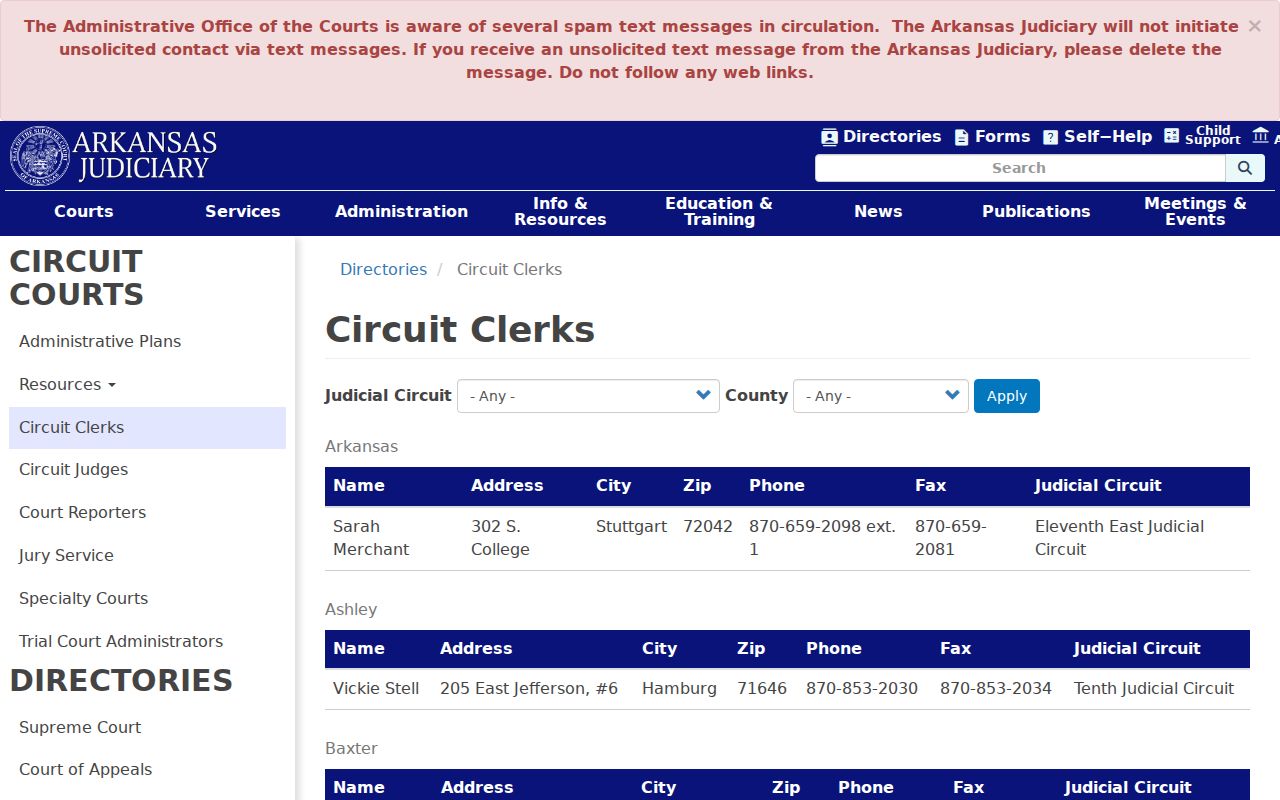
That directory tells you who keeps the record. For the specifics of one Sevier civil setting, check Search ARCourts events, any filed notices, and the division assigned to the case.
- Setting
- A scheduled court event, not necessarily a trial or final hearing.
- Continuance
- An order or action that moves a setting to another date.
- Bench trial
- A trial decided by the judge without a jury.
- Rule 41 review
- A review of inactive civil matters that may lead to a warning and possible dismissal.
Sevier Rule 41 Docket Review
Sevier County has a distinctive docket-management habit worth knowing. Ninth West administrators pull statistical dashboards at least twice a year to review active files. Probate gets reviewed annually. A case that sits idle can draw a warning letter. From there it may be referred for dismissal under Arkansas Rule of Civil Procedure 41. So a long stretch with no filing can have an effect. It can suddenly bring new notice and dismissal-review entries on the docket.
Do not read a Rule 41 warning as the end. Look at the entries that come after it. A party can respond, the case can pick back up, or the court can enter a dismissal. The order itself is the only entry that shows the result. Filings can even continue after the status looks closed. A Sevier County civil docket search should reach past the first disposition line.
Read the next entry: A motion is not an order, a warning is not a dismissal, and a setting is not proof that a hearing occurred.
Sevier Civil Post-Judgment Dockets
Judgments rarely close out a Sevier County civil docket for good. A writ, garnishment, satisfaction, appeal, or enforcement order can each add entries later. If collection history or current status matters, scan past the first disposition row. Appeals split things further. A District civil appeal moves under the applicable rules to Circuit Court, and a Circuit decision can climb to an Arkansas appellate court. That creates a fresh docket and case number at each level. Search every court on its own terms.
Public Access to Civil Dockets
What counts as public in a Sevier County court docket? Arkansas Supreme Court Administrative Order 19 draws that line. It opens court records to the public. At the same time, it shields anything that law, rule, or a judge's order makes confidential. So expect redactions. Protected identifiers, sealed filings, and certain domestic-relations, juvenile, guardianship, adoption, medical, and financial details can be blanked out or withheld entirely. A case can even show a public docket online with no image for a protected filing.
When Search ARCourts leaves you short, go to the office that holds the file. Circuit civil and domestic cases sit with the Circuit Clerk. Lower civil and small claims belong to the District clerk. Probate goes to the County Clerk. Call before you go if the case is old. Also call if you are unsure which office holds it. A written request by mail works too. One caution: published Circuit fax numbers conflict, listing both 870-642-8061 and 870-642-3119, so confirm which one is live. The County Clerk fax is 870-642-3896. Ask, too, whether a public-view station in the office shows images you cannot pull up from home.
Access point: The Arkansas Freedom of Information Act supplies general request methods, but Administrative Order 19 primarily governs court case records.
Sevier Civil Judgments and Copies
If a judgment image is missing, write down the case number. Add the Docket Entry date and the exact description. Then call the Sevier County Circuit Clerk at 870-584-3055. Or visit 115 North Third Street in De Queen. The clerk's official schedule lists $0.50 per page for Circuit copies, with $5 for certification or $5 for authentication. Confirm the total, payment method, and delivery option before you send money. Probate works differently. The County Clerk's schedule adds a $20 research charge plus copies. Copies run $0.50 per page when the customer researches, $1 per page when the clerk researches, and $5 for a seal or certification. Those fees carry older revision dates, so verify them. Across all courts, remember the distinction. A portal printout is case information, an image is a filed document, and a certified copy is the clerk-attested official record. Older Circuit files may need an archive search. The Circuit Clerk reports holdings reaching back to the 1830s. Give staff names, a rough date range, court type, and any known number so they can check electronic images, paper jackets, microfilm, indexes, or bound dockets.